Showing posts with label gay paranormal. Show all posts

Wednesday, May 29, 2024

My Chilling Vampire Novel, IMMORTAL THINGS, is Now Out in Audiobook


My #vampire #lovestory, IMMORTAL THINGS, is now available in #audiobook, narrated by the talented Sandra Sandy Detweiler. The book chronicles the intersection of three immortals, with their own very different stories, and the streetwalker/artist who comes into their midst, setting off an unforgettable and explosive reaction.


About the Book

By day, Elise draws and paints, spilling out the horrific visions of her tortured mind. By night, she walks the streets, selling her body to the highest bidder.

And then they come into her life: a trio of impossibly beautiful vampires: Terence, Maria, and Edward. When they encounter Elise, they set an explosive triangle in motion

Terence wants to drain her blood. Maria wants Elise . . . as lover and partner through eternity. And Edward, the most recently converted, wants to prevent her from making the same mistake he made as a young abstract expressionist artist in 1950s Greenwich Village: sacrificing his artistic vision for immortal life. He is the only one of them still human enough to realize what an unholy trade this is.

Immortal Things will grip you in a vise of suspense that won’t let go until the very last moment…when a shocking turn of events changes everything and demonstrates—truly—what love and sacrifice are all about.

Excerpt

Immortal Things
Rick R. Reed © 2021
All Rights Reserved

Prologue
No one can hear the screams, the cries for mercy, and the shrieks of agony. It is as though the house is alive and it clamps down in reaction to the turmoil going on inside. One would never guess from its calm exterior that blood drips from its walls and those unlucky enough to enter have a good chance never to emerge again.

This house appears to be empty. Dignified. Crumbling testimony to the wealth that once existed on Chicago’s Far North Side. It sits like a boulder on a corner, empty-eye-socket windows facing Sheridan Road and beyond it, the expanse of Lake Michigan. The lake is dark now; white-tipped waves crash against the shoreline, breaking at the boulders, a crescent moon bisected and wobbling on its black and churning waters. The house has borne witness to these waters, moody and changeable, always fickle, for more than a hundred years.

The house is fashioned from white brick, yellowed and dirty. Nothing grows in the yard, save for a few straggling weeds that refuse to give in to the barren soil.

The house is dead.

And so are its inhabitants.

*****

The dead are inside and reveal a surprising likeness to living creatures. They can move and speak just like the rest of us. They have wants and needs. They go about fulfilling these wants and needs with the same kind of intensity and purpose as the rest of the world. One could even say they have jobs, even if their occupations would be deemed illegal and certainly immoral by almost everyone.

But look beyond these superficial similarities and you’ll feel chilled. Touch their flesh and it’s cold. Lay your head at their breasts and hear…nothing. Look into their eyes and find yourself reflected back in a black void that you just know, if you linger too long in its embrace, you’ll be sucked in and it will be all over for you. Grab one of their cold wrists and feel stone, marble to be exact.

There is no pulse.

But tonight, they are a merry band of three. Like the living, they are filled with anticipation. An evening out awaits them. They will, like so many others getting ready for a night on the town, meet others, exchange knowing glances and a mating dance of words. They will sup, but not on the gourmet offerings of the city.

Most houses borne of this period contain many rooms, perhaps more than necessary. Whoever designed this house had the presence of mind to create wide-open spaces, breathing room. Enter the double front doors and you come directly into the living room. Or is it a drawing room? A great room? No matter. What you do not enter is a vestibule or a foyer as other houses of this period would contain. The walls are parchment colored, but right now, that color is indiscernible to the human eye, lit as they are by dozens of flickering candles. Water stains mar the walls and give to them a trompe l’oeil elegance, a look of almost deliberate aging. The floors are dark, their hardwood planks, tongue and groove, blackened by the lack of light and dust accumulated over many years. Along one wall is a fieldstone fireplace, its mantel tall as a man, its hearth cold and empty.

There is no furniture in this huge room. No chairs. No tables. No bookcases or desks. No divans or chaise lounges.

What does occupy the room, other than these three lifeless, yet curiously beautiful souls, is art. Paintings of every period lean against the wall and hang from their crumbling surfaces. Here is one after the style of Rubens, there another that looks pre-Raphaelite, here a Picasso…Jackson Pollock…Monet…Keith Haring…Willem de Kooning…Mark Rothko…Barnett Newman…plus the works of a legion of unknown artists, in every style and medium imaginable. The walls are crowded with it. The room is a gallery assembled by someone with vast resources, but tastes that go beyond eclectic. The only common theme running through these works is that all are unique. There is a respect for form, for color, for technique. Most of all, there is a certain indefinable quality that manages to capture the human spirit in its delicacy, in its discontent, in its hunger.

Perhaps it’s the hunger that appeals to them.

And the floor is a cocktail party of human sculptures. Men and women carved from marble, granite, and alabaster, cast in bronze. There are later figures cast from polymers, smooth acrylic, welded metals.

It is eerie—this empty house that has become museum or mausoleum.

Or both.

But art is what the dead crave. It sustains them—that and something else—something warmer and more vibrant, but they are too genteel to admit to such hungers. Like animals, they simply feed when they are hungry and discuss it as little as possible.

The walls also contain long leaded-glass windows, through which, appropriately enough, a full moon sends its pale rays, distorted and laying upon the darkened wood like silver. The leaded glass has become opaque, obscured by layers of dust, grime, and accumulated smoke.

And we can see the creatures now, gathering. Listen: and hear nothing save for the creaking of ancient floorboards.

First, let us consider Terence, broad shoulders cloaked in a pewter, latex zippered vest open just enough to display the cleft between smooth and defined pecs, tight leather jeans, and biker boots. Blond hair frames his face in leonine splendor: thick, straight, and shining, it flows to just below his shoulders. Glint of silver on both ears, studs moving like an iridescent slug upward. Terence is the second oldest of the three. His skin, like the others, has the look and feel of alabaster. Dark eyes burn from within this whiteness and present a startling contrast. Terence is a study in symmetry: his wide-set eyes match each other perfectly, his aquiline nose bisects dramatic cheekbones, and his full lips speak volumes about sensuality and lust. Stare into Terence’s eyes and gain a glimpse—quick, like a jump cut in a movie—of cobblestone streets, horse-drawn carriages, and the grime and elegance that was London in the late 1800s. Shake your head and the image disperses and you are left thinking it’s only your imagination conjuring up these images. After all, what does this post-punk Adonis have to do with the British Empire in the time of Oscar Wilde? Besides, Terence’s smile will have you thinking only of the present. And the present is what Terence lives for—the pleasure he can find, the communion of flesh and blood, seemingly so religious and yet sent from hell. He throws back his head and does a runway model turn, for the benefit of his companion, Edward, who rolls his eyes and snickers. “Don’t look to me to be one of your adoring minions.”

Let’s shift our focus to Edward. Edward is musculature in miniature, stubbled face and a shaved pate. Leather vest, black cargo pants tucked into construction worker boots, no jewelry save for the inverted cross glinting gold between shaved and defined pecs. On his bicep, a tattooed band: marijuana leaves repeated over and over, rimmed with a thick black line. Edward’s look would be comfortable in the leather bars along Halsted Street, and he is the only one of the three who prefers the embraces of men. He is relatively young, a newcomer to this scene of death and the greedy stealing of life. Watch him carefully and you will detect a hint of uncertainty in his handsome, rugged features. Melancholy haunts his dark eyes, which, unlike Terence’s, are not symmetrical: the left is a little smaller than the right and crinkles more when he laughs, which is seldom. Curiously, though, it is Edward’s features that look most human…because it’s humanity that lacks perfection and Edward hasn’t been of this undead world long enough to adopt its slick veneer of beauty that’s too perfect to be real or wholesome. Look into Edward’s eyes and you’ll see a beatnik Greenwich Village, a more personal vision: an artist’s studio which is nothing more than a cramped room with bad light with canvases he worked on night and day, brilliant blends of color and construction for which Edward had no name, but one day would be called abstract expressionism.

Shake your head, and—as with Terence—these images disperse. There’s nothing there, save for this macho gay clone boy with eyes that still manage to sparkle, in spite of the thin veneer of sadness and remorse deep within them.

And last comes Maria, on silent cat feet, moving down the stairs. A whisper of satin, the color of coagulating blood: rust and dying roses, corseted at the waist with black leather. Black hair falls to her shoulders, straight, each strand perfect, sometimes flickering red from the candles’ luminance. Dark eyes and full crimson lips. Maria stands over six feet, and her body, even beneath the dress, is a study in strength: muscles taut, defined, like a man save for the fact that the muscles speak a hypnotic feminine language: sinew locked with flesh in elegance and grace. “Feline” would not be going too far were one to describe her. There is the same grace, the same frightening coiled-up power, perfect for the hunt, perfect for surprising and making quick work of her prey.

She pauses, turning slowly in front of the men, her men, waiting for an appraisal. And, unlike Terence, this move does not seem vain, but more her due.

The men applaud softly and Maria stops, dark eyes boring into theirs. They do not see the watery streets of Venice, but you would, if you dared to engage her gaze for long. Dark canals and mossy mildew-stained walls, crumbling stairs at which black water laps, an open window through which one hears an aria. Smell the mildew and the damp.

The three take seats on the dusty floor, bring out mind-altering paraphernalia.

Terence, first: “Whom will we lure tonight?”

And Edward, eyes cast downward, the candle flames reflected off his bald and shining pate, sighs.

It is Maria who touches him, her hand a whisper, but with the tightness of a claw against his shoulder, forcing him to look up into her eyes. “I know it’s hard. But eventually you’ll come to understand, to be like Terence and enjoy what is natural.”

Edward laughs, but there is no mirth in it. “Natural? You call what we do natural?”

“We are God’s creatures, just like the ones we prey upon. Just as an owl preys upon a mouse. We have needs and we do what we must to satisfy them—or else we die.”

“We’re already dead,” Edward says.

Maria picks up a glass cylinder and looks at it critically for a moment. “Legend looks at us that way. That much is true.” At the top of the cylinder is a small bowl, which Maria stuffs with sticky, green bud. The smell of marijuana is redolent in the air, mixing with the burning wax of the candles. “But I prefer to think of us as another species. A different kind of animal.”

Edward stares at the silver light coming in through the long leaded-glass windows. It has been more than fifty years since he first met Terence in a tiny basement bar in Greenwich Village. Fifty years since he transformed himself into this new kind of animal Maria is now trying to make him think he is, to excuse their killing, the mayhem they wreak wherever they go. The heartbreak and the bloodshed, the latter so delicious, and so damning. Will he ever become callous enough to view what they do and what they are, like Maria? Will he ever be able to look at one of their victims, convulsing before them on a grimy floor, surrendering to death, and see them as merely sustenance? He’ll never believe it.

The most curious thing about his transformation is this: time has taken on completely different dimensions.

Five decades have passed like five days. It makes eternity easier to bear, he supposes.

“If that’s what gets you through the night, Maria, fine. And as for being like Terence one day, well, that’s a hell I hope to never visit.”

His last comment elicits a snort from Terence, who seems to either find everything humorous or everything sexy. He lives for pleasure. Sometimes, Edward wishes he could be like him. Terence has no conscience. It would be easier to be so ignorant.

“Here.” Maria hands him the glass cylinder, the thing that in a head shop would be called a Steamroller, and Edward fishes in his vest pocket for a disposable lighter. He fires it up and holds it to the little ashen bowl topping the cylinder, watching as it grows orange and holding his hand over the open end of the tube. It fills with smoke. When Edward removes his hand, the blue-gray smoke rolls toward him, into his open mouth, and he longs for the oblivion he knows it will bring. He holds the smoke deep in his lungs and then exhales. It doesn’t take much of this stuff to change his mood, to make him forget, and for that, he’s grateful.

He hands the cylinder to Terence, who locks his hand over his and stares into his eyes. “You always were so beautiful,” he whispers.

“You always were such a liar.”

And the merry band of three becomes silent and a little less merry. They know the truth: Terence is a liar, and had it not been for his charm and deceptions, Edward would not be with them tonight.

No, Edward would not be with them. He would be a man in his seventies by now, either a bum or a respected abstract expressionist painter; in the movie of his life, someone short but muscular would play him; the title of this film would not be Pollock, but Tanguy. Instead, Edward was no longer an artist, no longer a human being really. No, he is now a creature who has made stealth and superhuman attunement his artistic expression. He thinks, with a dark snort, that all he draws now is blood.

Maria’s cold, satin flesh takes hold of his forearm; the slight pressure of her nails: the gentle touch of a bird of prey’s talons. Even with his own kind, Edward thinks, one can’t be too careful.

She knows he is not attuned to the night, but is depressed and resigned to the hunt. He has never fully realized the joy of taking sustenance. Maria stares into his black irises with her own pitch orbs, and smiles. She licks her lips and raises her nose to sniff. “Mmm. Can’t you smell them, Edward? The sharp, hot tang?” She closes her eyes in a kind of rapture, breathing in deeply. The smell of people wafts through the hot summer air, as much a background as the bleating horns, exhausts, and squealing brakes from the cars on Sheridan Road.

Edward allows Maria to lead him to the front door. Puncture or perish is the joke he whispered to himself.

Terence waits at the curb, his big Harley churning and revving. He grins and one can see, even from yards away, Terence’s eyes twinkling with anticipation.

Edward thinks as he descends the wide flight of stairs, Maria clutching his arm, that Terence is the luckiest of the three because he feels no remorse.

He has no heart.

BUY

NineStar Press | Books2Read | Amazon | Audible


Friday, December 22, 2023

NOW OUT! HERE COMES THE SUN A Poignant Vampire Tale


Very proud of my haunting story about a vampire on the cusp of an important decision...

In the ethereal stillness of a desert mountaintop, Asa Beck, a timeless figure bound by the chains of immortality, grapples with the weight of his existence. The impending sunrise paints the horizon with hues of amber and gold, signaling both beauty and an inevitable reckoning for this centuries-old vampire.

As Asa perches on the precipice of his eternal twilight, he confronts a past etched with torment and shadows—a legacy of immortality that bears the scars of a life lived in perpetual darkness. The origin of his immortal curse emerges like a haunting melody, weaving through his thoughts—a twisted path that seduced him into embracing the shadows within, while a relentless thirst clawed at the fabric of his soul.

Yet amid this bleak tapestry, a bittersweet ember glows—the memory of a forbidden love. In the vast expanse of his endless night, there existed one soul that dared to intertwine with his. A human heart that beat in synchrony with his own, a beacon of light that briefly illuminated the abyss of his existence.

With the impending sunrise heralding an existential crossroad, Asa's mind wanders to the pivotal choice that awaits him. Does he continue his existence as a creature of the night, forever haunted by the echoes of his past and the insatiable hunger that defines him? Or does he yearn for redemption, seeking solace in the eternal slumber that awaits with the breaking dawn?

As the first rays of light crest the horizon, casting elongated shadows upon the desolate landscape, Asa Beck, the wanderer cursed with immortality, stands at the nexus of decision. His fate, eternal and uncertain, hangs in the balance—a pivotal moment that will define the trajectory of his timeless existence.

In this tale of eternal struggle and poignant love, Asa Beck's journey transcends the realms of mortality and immortality. It delves into the depths of the human spirit, exploring the haunting beauty of love against the backdrop of an endless night—a saga that echoes the universal quest for purpose and redemption in the face of eternity.

Grab yours and read by the light of the sun:

Tuesday, September 19, 2023

My Vampire Novel, IMMORTAL THINGS, Is About Love, Immortality and Art


About the Book

By day, Elise draws and paints, spilling out the horrific visions of her tortured mind. By night, she walks the streets, selling her body to the highest bidder.

And then they come into her life: a trio of impossibly beautiful vampires: Terence, Maria, and Edward. When they encounter Elise, they set an explosive triangle in motion

Terence wants to drain her blood. Maria wants Elise . . . as lover and partner through eternity. And Edward, the most recently converted, wants to prevent her from making the same mistake he made as a young abstract expressionist artist in 1950s Greenwich Village: sacrificing his artistic vision for immortal life. He is the only one of them still human enough to realize what an unholy trade this is.

Immortal Things will grip you in a vise of suspense that won’t let go until the very last moment…when a shocking turn of events changes everything and demonstrates—truly—what love and sacrifice are all about.

Excerpt

Immortal Things
Rick R. Reed © 2021
All Rights Reserved

Prologue
No one can hear the screams, the cries for mercy, and the shrieks of agony. It is as though the house is alive and it clamps down in reaction to the turmoil going on inside. One would never guess from its calm exterior that blood drips from its walls and those unlucky enough to enter have a good chance never to emerge again.

This house appears to be empty. Dignified. Crumbling testimony to the wealth that once existed on Chicago’s Far North Side. It sits like a boulder on a corner, empty-eye-socket windows facing Sheridan Road and beyond it, the expanse of Lake Michigan. The lake is dark now; white-tipped waves crash against the shoreline, breaking at the boulders, a crescent moon bisected and wobbling on its black and churning waters. The house has borne witness to these waters, moody and changeable, always fickle, for more than a hundred years.

The house is fashioned from white brick, yellowed and dirty. Nothing grows in the yard, save for a few straggling weeds that refuse to give in to the barren soil.

The house is dead.

And so are its inhabitants.

*****

The dead are inside and reveal a surprising likeness to living creatures. They can move and speak just like the rest of us. They have wants and needs. They go about fulfilling these wants and needs with the same kind of intensity and purpose as the rest of the world. One could even say they have jobs, even if their occupations would be deemed illegal and certainly immoral by almost everyone.

But look beyond these superficial similarities and you’ll feel chilled. Touch their flesh and it’s cold. Lay your head at their breasts and hear…nothing. Look into their eyes and find yourself reflected back in a black void that you just know, if you linger too long in its embrace, you’ll be sucked in and it will be all over for you. Grab one of their cold wrists and feel stone, marble to be exact.

There is no pulse.

But tonight, they are a merry band of three. Like the living, they are filled with anticipation. An evening out awaits them. They will, like so many others getting ready for a night on the town, meet others, exchange knowing glances and a mating dance of words. They will sup, but not on the gourmet offerings of the city.

Most houses borne of this period contain many rooms, perhaps more than necessary. Whoever designed this house had the presence of mind to create wide-open spaces, breathing room. Enter the double front doors and you come directly into the living room. Or is it a drawing room? A great room? No matter. What you do not enter is a vestibule or a foyer as other houses of this period would contain. The walls are parchment colored, but right now, that color is indiscernible to the human eye, lit as they are by dozens of flickering candles. Water stains mar the walls and give to them a trompe l’oeil elegance, a look of almost deliberate aging. The floors are dark, their hardwood planks, tongue and groove, blackened by the lack of light and dust accumulated over many years. Along one wall is a fieldstone fireplace, its mantel tall as a man, its hearth cold and empty.

There is no furniture in this huge room. No chairs. No tables. No bookcases or desks. No divans or chaise lounges.

What does occupy the room, other than these three lifeless, yet curiously beautiful souls, is art. Paintings of every period lean against the wall and hang from their crumbling surfaces. Here is one after the style of Rubens, there another that looks pre-Raphaelite, here a Picasso…Jackson Pollock…Monet…Keith Haring…Willem de Kooning…Mark Rothko…Barnett Newman…plus the works of a legion of unknown artists, in every style and medium imaginable. The walls are crowded with it. The room is a gallery assembled by someone with vast resources, but tastes that go beyond eclectic. The only common theme running through these works is that all are unique. There is a respect for form, for color, for technique. Most of all, there is a certain indefinable quality that manages to capture the human spirit in its delicacy, in its discontent, in its hunger.

Perhaps it’s the hunger that appeals to them.

And the floor is a cocktail party of human sculptures. Men and women carved from marble, granite, and alabaster, cast in bronze. There are later figures cast from polymers, smooth acrylic, welded metals.

It is eerie—this empty house that has become museum or mausoleum.

Or both.

But art is what the dead crave. It sustains them—that and something else—something warmer and more vibrant, but they are too genteel to admit to such hungers. Like animals, they simply feed when they are hungry and discuss it as little as possible.

The walls also contain long leaded-glass windows, through which, appropriately enough, a full moon sends its pale rays, distorted and laying upon the darkened wood like silver. The leaded glass has become opaque, obscured by layers of dust, grime, and accumulated smoke.

And we can see the creatures now, gathering. Listen: and hear nothing save for the creaking of ancient floorboards.

First, let us consider Terence, broad shoulders cloaked in a pewter, latex zippered vest open just enough to display the cleft between smooth and defined pecs, tight leather jeans, and biker boots. Blond hair frames his face in leonine splendor: thick, straight, and shining, it flows to just below his shoulders. Glint of silver on both ears, studs moving like an iridescent slug upward. Terence is the second oldest of the three. His skin, like the others, has the look and feel of alabaster. Dark eyes burn from within this whiteness and present a startling contrast. Terence is a study in symmetry: his wide-set eyes match each other perfectly, his aquiline nose bisects dramatic cheekbones, and his full lips speak volumes about sensuality and lust. Stare into Terence’s eyes and gain a glimpse—quick, like a jump cut in a movie—of cobblestone streets, horse-drawn carriages, and the grime and elegance that was London in the late 1800s. Shake your head and the image disperses and you are left thinking it’s only your imagination conjuring up these images. After all, what does this post-punk Adonis have to do with the British Empire in the time of Oscar Wilde? Besides, Terence’s smile will have you thinking only of the present. And the present is what Terence lives for—the pleasure he can find, the communion of flesh and blood, seemingly so religious and yet sent from hell. He throws back his head and does a runway model turn, for the benefit of his companion, Edward, who rolls his eyes and snickers. “Don’t look to me to be one of your adoring minions.”

Let’s shift our focus to Edward. Edward is musculature in miniature, stubbled face and a shaved pate. Leather vest, black cargo pants tucked into construction worker boots, no jewelry save for the inverted cross glinting gold between shaved and defined pecs. On his bicep, a tattooed band: marijuana leaves repeated over and over, rimmed with a thick black line. Edward’s look would be comfortable in the leather bars along Halsted Street, and he is the only one of the three who prefers the embraces of men. He is relatively young, a newcomer to this scene of death and the greedy stealing of life. Watch him carefully and you will detect a hint of uncertainty in his handsome, rugged features. Melancholy haunts his dark eyes, which, unlike Terence’s, are not symmetrical: the left is a little smaller than the right and crinkles more when he laughs, which is seldom. Curiously, though, it is Edward’s features that look most human…because it’s humanity that lacks perfection and Edward hasn’t been of this undead world long enough to adopt its slick veneer of beauty that’s too perfect to be real or wholesome. Look into Edward’s eyes and you’ll see a beatnik Greenwich Village, a more personal vision: an artist’s studio which is nothing more than a cramped room with bad light with canvases he worked on night and day, brilliant blends of color and construction for which Edward had no name, but one day would be called abstract expressionism.

Shake your head, and—as with Terence—these images disperse. There’s nothing there, save for this macho gay clone boy with eyes that still manage to sparkle, in spite of the thin veneer of sadness and remorse deep within them.

And last comes Maria, on silent cat feet, moving down the stairs. A whisper of satin, the color of coagulating blood: rust and dying roses, corseted at the waist with black leather. Black hair falls to her shoulders, straight, each strand perfect, sometimes flickering red from the candles’ luminance. Dark eyes and full crimson lips. Maria stands over six feet, and her body, even beneath the dress, is a study in strength: muscles taut, defined, like a man save for the fact that the muscles speak a hypnotic feminine language: sinew locked with flesh in elegance and grace. “Feline” would not be going too far were one to describe her. There is the same grace, the same frightening coiled-up power, perfect for the hunt, perfect for surprising and making quick work of her prey.

She pauses, turning slowly in front of the men, her men, waiting for an appraisal. And, unlike Terence, this move does not seem vain, but more her due.

The men applaud softly and Maria stops, dark eyes boring into theirs. They do not see the watery streets of Venice, but you would, if you dared to engage her gaze for long. Dark canals and mossy mildew-stained walls, crumbling stairs at which black water laps, an open window through which one hears an aria. Smell the mildew and the damp.

The three take seats on the dusty floor, bring out mind-altering paraphernalia.

Terence, first: “Whom will we lure tonight?”

And Edward, eyes cast downward, the candle flames reflected off his bald and shining pate, sighs.

It is Maria who touches him, her hand a whisper, but with the tightness of a claw against his shoulder, forcing him to look up into her eyes. “I know it’s hard. But eventually you’ll come to understand, to be like Terence and enjoy what is natural.”

Edward laughs, but there is no mirth in it. “Natural? You call what we do natural?”

“We are God’s creatures, just like the ones we prey upon. Just as an owl preys upon a mouse. We have needs and we do what we must to satisfy them—or else we die.”

“We’re already dead,” Edward says.

Maria picks up a glass cylinder and looks at it critically for a moment. “Legend looks at us that way. That much is true.” At the top of the cylinder is a small bowl, which Maria stuffs with sticky, green bud. The smell of marijuana is redolent in the air, mixing with the burning wax of the candles. “But I prefer to think of us as another species. A different kind of animal.”

Edward stares at the silver light coming in through the long leaded-glass windows. It has been more than fifty years since he first met Terence in a tiny basement bar in Greenwich Village. Fifty years since he transformed himself into this new kind of animal Maria is now trying to make him think he is, to excuse their killing, the mayhem they wreak wherever they go. The heartbreak and the bloodshed, the latter so delicious, and so damning. Will he ever become callous enough to view what they do and what they are, like Maria? Will he ever be able to look at one of their victims, convulsing before them on a grimy floor, surrendering to death, and see them as merely sustenance? He’ll never believe it.

The most curious thing about his transformation is this: time has taken on completely different dimensions.

Five decades have passed like five days. It makes eternity easier to bear, he supposes.

“If that’s what gets you through the night, Maria, fine. And as for being like Terence one day, well, that’s a hell I hope to never visit.”

His last comment elicits a snort from Terence, who seems to either find everything humorous or everything sexy. He lives for pleasure. Sometimes, Edward wishes he could be like him. Terence has no conscience. It would be easier to be so ignorant.

“Here.” Maria hands him the glass cylinder, the thing that in a head shop would be called a Steamroller, and Edward fishes in his vest pocket for a disposable lighter. He fires it up and holds it to the little ashen bowl topping the cylinder, watching as it grows orange and holding his hand over the open end of the tube. It fills with smoke. When Edward removes his hand, the blue-gray smoke rolls toward him, into his open mouth, and he longs for the oblivion he knows it will bring. He holds the smoke deep in his lungs and then exhales. It doesn’t take much of this stuff to change his mood, to make him forget, and for that, he’s grateful.

He hands the cylinder to Terence, who locks his hand over his and stares into his eyes. “You always were so beautiful,” he whispers.

“You always were such a liar.”

And the merry band of three becomes silent and a little less merry. They know the truth: Terence is a liar, and had it not been for his charm and deceptions, Edward would not be with them tonight.

No, Edward would not be with them. He would be a man in his seventies by now, either a bum or a respected abstract expressionist painter; in the movie of his life, someone short but muscular would play him; the title of this film would not be Pollock, but Tanguy. Instead, Edward was no longer an artist, no longer a human being really. No, he is now a creature who has made stealth and superhuman attunement his artistic expression. He thinks, with a dark snort, that all he draws now is blood.

Maria’s cold, satin flesh takes hold of his forearm; the slight pressure of her nails: the gentle touch of a bird of prey’s talons. Even with his own kind, Edward thinks, one can’t be too careful.

She knows he is not attuned to the night, but is depressed and resigned to the hunt. He has never fully realized the joy of taking sustenance. Maria stares into his black irises with her own pitch orbs, and smiles. She licks her lips and raises her nose to sniff. “Mmm. Can’t you smell them, Edward? The sharp, hot tang?” She closes her eyes in a kind of rapture, breathing in deeply. The smell of people wafts through the hot summer air, as much a background as the bleating horns, exhausts, and squealing brakes from the cars on Sheridan Road.

Edward allows Maria to lead him to the front door. Puncture or perish is the joke he whispered to himself.

Terence waits at the curb, his big Harley churning and revving. He grins and one can see, even from yards away, Terence’s eyes twinkling with anticipation.

Edward thinks as he descends the wide flight of stairs, Maria clutching his arm, that Terence is the luckiest of the three because he feels no remorse.

He has no heart.

BUY

NineStar Press | Books2Read | Amazon


Saturday, July 1, 2023

THIRD EYE A Psychic, Two Diabolical Killers, and a Journey Into Nightmare and Redemption


THIRD EYE is my thriller about a psychic and his reluctant visions into the murders of young women in small-town Appalachia. The awesome cover art is by Natasha Snow.

BUY


ABOUT THE BOOK

Who knew that a summer thunderstorm and a lost little boy would conspire to change single dad Cayce D’Amico’s life in an instant? With Luke missing, Cayce ventures into the woods near their house to find his son, only to have lightning strike a tree near him, sending a branch down on his head. When he awakens the next day in the hospital, he discovers he has been blessed or cursed—he isn’t sure which—with psychic ability. Along with unfathomable glimpses into the lives of those around him, he’s getting visions of a missing teenage girl.

When a second girl disappears soon after the first, Cayce realizes his visions are leading him to their grisly fates. Cayce wants to help, but no one believes him. The police are suspicious. The press wants to exploit him. And the girls’ parents have mixed feelings about the young man with the “third eye.”

Cayce turns to local reporter Dave Newton and, while searching for clues to the string of disappearances and possible murders, a spark ignites between them. Little do they know that nearby, another couple—dark and murderous—are plotting more crimes and wondering how to silence the man who knows too much about them.


EXCERPT


Third Eye
Rick R. Reed © 2020
All Rights Reserved

Prologue
She was only thirteen. It wasn’t fair she now lay, bound, waiting for death. Before, there had been struggling: clawing and fighting, scratching their faces, pulling at their hair, batting at whatever part she could reach. Her breath had come in choking spasms, adrenaline pumping, burning, anteing up the hysteria so much she thought her air would be blocked. Then had come the dread that made her lose most of her fight, when her terror-addled brain had begun to accept her fate was to die here, in this tiny, hot room, with the only witness to her demise the sparkling eyes of her killers and the maddening, crooked whirl of a ceiling fan long past its prime and wobbling, doing nothing more than blowing the overheated, moist air around the room. The dread had risen up, a nausea twisting her gut and making her afraid she would vomit. And then had come the numbness, a dull tingling throughout her body that precluded movement, stripping her of coherent thought.

They stood above her. Faces she had trusted, faces she had seen before, around her neighborhood. The man she and her friends had had a crush on. He used to drive by her little house on Ohio Street in his old red Mustang, looking the picture of youth, confidence, masculinity. His hair was dark, cut bristle-brush short, and his face always clean-shaven. Thin lips bordered rows of perfect white teeth, and when he had smiled at her, only hours ago, she had lit up. A tingling had started in her toes and had worked its way up until the color rose to her cheeks. At her young age, the interest of a man in his twenties was inconceivable, although it had been something she had hoped for since the first day she had seen him, back at the onset of summer, when the sun had turned white-hot, burning up the grass and making illusory waves rise from the hot, cracked sidewalks.

He had pulled to the curb and sat there, car idling. She sat in the front yard, sorting through Barbie clothes: ball gowns and swimming suits, miniskirts and stretch pants. He didn’t say anything, not right away. She had looked at him once, then looked away, certain his interest could never be in her. Suddenly she felt ridiculous with her metal trunk, her Barbie dolls, and all the outfits she had once been so proud to collect. Swiftly, she returned the clothes to their case and slammed it shut.

She leaned back, resting on her palms, and lifted her face to the sun. Its heat beat down relentlessly, making the skin on her face feel tight.

She felt his eyes on her still. She opened her own eyes a crack and regarded him peripherally. He really was looking at her! The adorable little smile that caused a dimple to rise in his right cheek deepened in the sun’s play of shadow and light. She leaned back more, left hand reaching out to surreptitiously move the Barbie trunk farther away. In this posture, here on the withered and brown grass, she felt that her breasts, little more than two tiny bumps an unkind boy at school had once referred to as her anthills, looked larger. She could be eighteen, couldn’t she? With the right makeup and her hair pulled up….

But now her long blonde hair was pulled back in a ponytail, clipped with a pink plastic barrette. She wore a pair of cutoff shorts and an oversized South Park T-shirt belonging to her older brother. He would have killed her had he known she was wearing it. But he was away at the Y’s summer camp and would never know the difference.

The idling of the car was like an animal purring.

And then the sun disappeared, and she sat in darkness. Beneath her closed lids, she sensed someone standing over her.

Why hadn’t she heard the slam of the car door? Her eyelids fluttered, but she did not open them. It would be just like her mother to come outside now and stand above her, hands on hips, and ask her what she thought she was doing.

“Lucy?”

Finally, she opened her eyes and blinked at the brightness of the August day. He was smiling. So unlike the other guys in Fawcettville, he was dressed in pressed black slacks and a collarless white shirt, buttoned to his neck.

“How did you know my name?”

“Oh, I make it my business to know the names of all the pretty young ladies around here.”

Lucy felt the heat rise to her face once more. She grinned and could not think of a single word to say.

“Playing Barbie?”

She shoved the case farther away, until it was completely out of her grasp. The case lay in the white heat, glinting, looking, she hoped, as if it had nothing to do with her.

“What? Oh…no, no. These are my little sister’s. She always makes such a mess of things, and I was just organizing for her.”

“What a good sister.”

“Yeah, well…”

The two said nothing for a while, and Lucy began to grow uncomfortable under his gaze. She shifted her long, tanned legs in front of her, crossing them at the ankle.

“I was driving by and saw you sitting there, and I had to tell you”—he hunkered down beside her—“what a lovely sight you are. It made me stop just to have a better look.”

She laughed and thought she sounded way too much like the thirteen-year-old she was. “Thank you,” she whispered, wondering where her voice had gone.

“No, thank you, for being here, for making the heat of this day a little more pleasant.”

Oh, stop! she wanted to cry out but whispered again, “Thank you.”

He leaned closer, enough for her to feel his breath near her ear. In spite of the day’s heat, his nearness caused gooseflesh to rise on her arms, her spine to tingle.

“Listen.” He glanced around the empty street with eyes like none she had ever seen: green, ringed with thick black lashes. And in his gaze was a conspiracy that included only the two of them. “My car has air-conditioning. I know this is out of the blue and all, but I wondered if you’d like to go for a ride with me.”

Lucy glanced back at her house. She wished suddenly she lived in a bigger house, in a better neighborhood. Here on this modest residential street close to the river, her small white clapboard house was surrounded by other houses very much like it, some of them covered in rusting aluminum siding. She pictured her mother inside, on a vinyl-covered kitchen chair, watching All My Children on a thirteen-inch portable TV on the Formica-topped kitchen table. Her mother, she knew, would never approve of what was transpiring here, right in her front yard.

He stood suddenly. “Okay, okay. I get the message.”

“Wait.” She sat up straighter. A pickup rumbled by and left in its wake a smell of exhaust and a rush of hot air.

He turned. “What? Need to get your mom’s permission?”

“Of course not!” Her voice came out higher than she would have liked, the whiny protest of a child. She stood. “I’d like to come with you. But I can’t stay out too long.” She was about to say “My mom will be worried” but realized how immature that would sound. “I’ve got some people I have to meet in a little while.”

He smiled. And the smile erased any nervousness she had about going with him. After all, she had seen him around the neighborhood dozens of times. He wasn’t exactly a stranger, not really.

“That’s fine, Lucy. I’ll have you back within an hour. I promise. I certainly wouldn’t want to get off on the wrong foot with you.” He winked, and she followed him to the waiting car.

Lucy tripped getting into the car. Her head bumped against the chrome surrounding the upper doorframe, and her hand slid across the black vinyl seat. The laugh that followed came out high and flighty, a little bird. Lucy reddened once more, embarrassed by her klutziness.

He was grinning, already behind the steering wheel. “Don’t worry about it. We are all prey to tiny lapses in coordination.”

He drummed his fingers on the steering wheel while Lucy settled beside him, doing her best to recover her composure. With elaborate care, she positioned herself on the seat and crossed her legs. She admired her legs and hoped he did too: long and tan, smooth, the legs of a woman.

It was then she felt, more than noticed, the presence of someone else in the car. Lucy turned and saw her for the first time. In the back sat a young woman. Her hair, like Lucy’s, was blonde, but more of a brassy platinum shade. She wore a pair of dark glasses with cat-eye frames, bright-red lipstick, and a silk scarf tied around her neck. Her simple white shift contrasted sharply with her peach-colored skin. Lucy thought she was about the most glamorous thing she had ever seen in Fawcettville.

He noticed her looking. “This is my girlfriend, Myra. Sweetheart, say hello to Lucy.”

“Hello, Lucy.”

Did Lucy detect a very slight British accent in the gravelly voice? Whatever it was, this woman seemed so self-possessed and confident, Lucy’s dismay that this man had a girlfriend was almost overridden. Lucy was fascinated.

Lucy turned back to the man. “I don’t think you told me your name.”

He laughed, and Lucy forgot about Myra. His laugh was musical, setting her heart to thumping. She wondered what it would be like to slide closer, to rest her head on his shoulder.

“It’s Ian.” He slid a pair of Ray-Bans over his green eyes and shifted the car into drive. They sped away from the curb.

Lucy watched as her little white house grew smaller in the side-view mirror.

It wasn’t long before they were pulling up in front of a trailer on the outskirts of town. Lucy was disappointed; the dwelling didn’t seem to fit Ian’s character at all. She had expected something more romantic: a houseboat moored on the Ohio River, a high-rise apartment in nearby Pittsburgh, a mansion, a log cabin, anything but a trailer.

And it wasn’t even a nice one. Set up on cinder blocks, the trailer was a big box wrapped in harvest gold and dingy white aluminum. A piece of the skirting had torn loose at one end, and there was rust around the corners.

Ian shut the car off and draped his arm across the back of Lucy’s seat. “It isn’t much, love, but it’s all I’ve got. Care to come inside, or should we take you home?”

“Oh, just take her home, Ian. She’ll be late for supper,” Myra said from the backseat, where she hid behind a cloud of cigarette smoke.

“I’d love to come inside. This is where you live, right?”

Ian laughed. “Yes, for now. Are you sure you have time?”

Lucy glanced down at her watch, embarrassed suddenly by the pink vinyl strap and the Hello Kitty face on the dial. She would have to get a new watch soon, no matter what. Mom would probably be wondering, right about now, where she had gone off to. “I have a little time. Let’s go in. I want to see.”

Lucy followed the two of them toward the trailer. Ahead of her there was a copse of maple trees on a bluff. The Ohio River, looking brown and stagnant in the milky white light, curved as it made its way south.

Inside, the sudden change from the day’s withering brightness to the dark interior blinded Lucy, and she felt her first moment of panic. Neither of them said anything, and she suddenly felt helpless. For the first time that day, she questioned their interest in her and thought herself foolish for not having wondered why a young couple in their twenties would want to bring her home.

But she did look older, didn’t she?

Of course she did. Ian confirmed it. “We’re going to have a glass of wine, Lucy. Would you care for one?”

A flush of pleasure rushed through her. They did think she was older, a peer. Perhaps they were just trying to make friends. Before the onset of the summer, she couldn’t recall having seen either of them before. But what would Mom say if she came home with liquor on her breath? She groped in her pocket, thankful for the piece of Bazooka there.

“Well, maybe I could have just a small one.”

“Excellent!” Ian clapped his hands together and went toward the wall behind him, where a portable kitchen waited. He took a jug of white wine from the refrigerator and poured three glasses.

After they were settled in the living room and Lucy’s eyes had adjusted to the dim lighting, she said, “This is much nicer than I thought.”

The couple exchanged glances, laughing, and Lucy wondered why. The place was run-down. The carpeting, a beige-and-brown tweed, was threadbare, and the furniture was a hodgepodge of mismatched pieces, all of it looking secondhand. The scarred coffee table contained an odd assortment of items: a book called Crime and Punishment, a ceramic skull, and two black votive candles set on tin jar lids.

But the dimness and stale air bothered her more than anything else. Why were all the curtains drawn? “It’s kind of dark in here, isn’t it?”

That remark they found amusing as well; their laughter began to make her uncomfortable. She scratched her arm.

Ian said, “Lucy, haven’t you noticed? It’s hot outside. It keeps things a little cooler if I keep the drapes drawn.”

Of course.

After they had finished their wine—well, after Ian and Myra had finished theirs; Lucy thought it tasted horrible—Ian disappeared for a moment. When he came back, he was carrying a video camera. It was one of those tiny ones you could almost palm in your hand, and the red light on it was blinking.

What was going on?

“Smile for the camera, Lucy.”

Lucy tried to smile, but things were getting too strange. She managed to turn up the corners of her lips in a grin. Suddenly, Myra was on the couch next to her, too close, really. Lucy smelled her perfume. It was too sweet, with a bitter undertone. It smelled like she had rubbed incense on herself. The scent of the perfume combined with cigarettes and wine caused Lucy to lean back, away from Myra. Suddenly, the woman didn’t seem as glamorous as she had in the car.

She put her arm around Lucy and mugged for the camera. “Come on, Lucy, smile!”

Lucy bit her lip, thinking of the Barbie trunk she had left on her front lawn. Kelsey Timmons, just down the street, wouldn’t be above taking the whole trunk home, especially with the golden opportunity Lucy was giving her. Kelsey had coveted Lucy’s Barbie collection since she had moved in down the street four years ago. “I think I’d like to go home now.” Lucy tried to look anywhere but into the lens of the camera. She wished he would turn it off.

“Nonsense!” Ian exclaimed.

“You just got here, dear,” Myra whispered to her. Her lips were too red, and Lucy suddenly felt sick.

“Please, I need to go home now.”

“Just a few more minutes.” Ian hunkered down in front of the two of them, moving the camera slowly up and down their bodies.

Lucy lifted the wine to her lips, just to have something to quell her mouth’s terrible dryness. She began to perspire, dampening at her armpits, her hairline. She whimpered, “You said no more than an hour.”

“Such a pretty girl,” Myra whispered, lifting Lucy’s ponytail and turning it in her hand. “Oh, to have such tresses. What I wouldn’t give to have hair this color.” She giggled. “Naturally, I mean.”

“Jealous?” Ian stood and aimed the camera down at the two of them.

Lucy shot up, heat and fear coalescing to make her sick. The walls of the trailer closed in. “I don’t feel so good. Can we go now?”


Ian set the camera down for a moment and gave her his most winning smile. “The answer to that question, my sweet, is no.”

BUY

Tuesday, April 25, 2023

Have DINNER AT THE BLUE MOON CAFE, Where Terror and Romance Are on the Menu


DINNER AT THE BLUE MOON CAFE is now out!

Get yours at Amazon or NineStar Press 

ABOUT THE BOOK

A monster moves through the night, hidden by the darkness, taking men, one by one, from Seattle’s gay gathering areas.

Amid an atmosphere of crippling fear, Thad Matthews finds his first true love working in an Italian restaurant called the Blue Moon Café. Sam Lupino is everything Thad has ever hoped for in a man: virile, sexy as hell, kind, and… he can cook!

As their romance heats up, the questions pile up. Who is the killer preying on Seattle’s gay men? What secrets is Sam’s Sicilian family hiding? And more importantly, why do Sam’s unexplained disappearances always coincide with the full moon?

The strength of Thad and Sam’s love will face the ultimate test when horrific revelations come to light beneath the full moon.

  
Get yours at Amazon or NineStar Press 

Genre: Paranormal, LGBTQIA+, chef, murders, werewolf, friendship, shifters, contemporary, Seattle, food, recipes

Excerpt

Dinner at the Blue Moon Café
Rick R. Reed © 2020
All Rights Reserved

Music from his clock radio woke Thad Matthews at 6:00 a.m. The song, “Smokestack Lightning,” yanked him from a heavy, dream-laden sleep. Its energy forced his eyes open wider, caused synapses, eight hours dormant, to tingle, and made him want to move. Nonetheless, he slapped at the snooze button, silencing the bluesy wail, rolled over, and then pulled the comforter over his head. He was glad he had tuned his clock radio to KPLU, Seattle’s only all-blues all-the-time station, but he desperately wanted to recapture just a few more minutes of his dream, in which he’d found himself on the moors of England. All he could recall was that the moors themselves were appropriately fog shrouded and lit with a silvery luminance from above. Someone waited for him in the shadows and fog. And he couldn’t, for the life of him, know for certain if that someone meant to do him harm or meant to just do him.

He’d been having a lot of sexual dreams lately.

As much as he wanted to unravel the mystery of the dream—and to perhaps savor the vague sexual vibrations he was getting from it—sleep eluded him. He found thoughts of the day crowding in, preventing even the most remote possibility of a recurrence of slumber.

Thad sat up in the four-poster, rubbing his eyes like a little boy, and wondered why he bothered setting an alarm. He had no job to go to, no pressing engagements, no muse to answer to—hell, he didn’t even have an appointment for an oil change.

This day, like all his others, stretched out before him completely unmarred with obligations other than the requirements life imposed upon him, such as eating and going to the bathroom, which the erection poking up under his sheets compelled him to take care of. He called this morning wood a pee-on, because once he had put that particular need to rest, it most often subsided.

After stumbling to the adjoining bathroom and letting go with a flow that caused a mighty sigh of relief to issue forth from him, he thought once again that maybe today should be the day he looked harder into getting himself some employment—anything to put him into contact with other people and to fill his waking hours. Lord knew he filled out enough applications and answered enough Help Wanted ads on Craigslist to keep the officials down at unemployment sending him checks. But all his efforts, dishearteningly, were ignored.

It had been nearly four months since he had been laid off at Perk, the national chain of coffee shops headquartered in suburban Shoreline. Thad had been there for six years, in the marketing department, spending his days writing clever sayings for paper coffee cups and point-of-purchase signs for the stores. It was a tough job, but someone had to do it. And writing phrases like “Plan on Being Spontaneous” paid the bills, even if it didn’t provide much creative or intellectual challenge. It helped sell coffee, and Thad never kidded himself: that’s why he was employed there.

Except now they didn’t need him anymore. Who would write the signs for their special Iced Coffee blend?

He gazed down at the bubbling golden froth in the toilet and flushed it away, along with his thoughts about his former job. He turned and rinsed his hands under the sink, then splashed cold water on his face. Standing up straight, he stared at his reflection in the medicine cabinet mirror.

“You’re too young for a life of leisure,” he said to his reflection, rubbing his hands through his short, coarse red hair, which stuck up in a multitude of directions. People paid good money for products that would make their hair look as fetchingly disheveled as Thad’s did right now. He peered closer at himself, taking inventory of his pale skin, his gray eyes, and the constellation of freckles that spanned his nose and the tops of his cheeks. He flexed, thinking he was looking a little flabby around the middle.

“Workout day. I’ll head over to the gym today. I need it.” He sucked in his gut and let it out again, thinking it was empty and needed refilling. A Pagliacci delivery pizza only went so far. His slumber and active dream life, he supposed, had all but digested the pie.

Thad moved to the bedroom and began tossing pillows on the floor to make up his bed. He wasn’t sure why he bothered with this either, since it was unlikely anyone would see the military-neat bed except for him, when he would approach it once more this evening just to mess it all up again. But it was important to Thad to have a routine. Otherwise his days would blend into one meaningless chunk of time, formless, without definition or purpose.

It was becoming increasingly hard enough to distinguish Tuesday from Thursday—or Sunday, for that matter.

Back when he was putting in forty-plus hours a week, he envied the increasing number of friends and acquaintances who had gotten laid off during the economic downturn. The money they made on unemployment seemed like enough—at least for him and his modest lifestyle in his Green Lake studio apartment—and the freedom they had seemed worth the cut in pay.

But now he wasn’t so sure. The uncertainty of what would happen if he still wasn’t working when the unemployment checks dwindled down to zero hung over him like a vague threat. And the freedom wasn’t really so great, when that same threat prevented him from spending much money, lest he should need it down the road for luxuries like food and a roof over his head.

Worst of all was what the job loss had done to his self-esteem. Thad needed some meaning in his life, a purpose. That much had been instilled in him since he was a little boy, back in Chicago growing up in the working class neighborhood of Bridgeport, where his father was a cop and his mother waited tables at a Lithuanian restaurant.

He pulled on a T-shirt and a pair of sweatpants, padded out to the office area of his apartment, and plopped down in front of his laptop. He planned to check out the classifieds on Craigslist, then Monster, then CareerBuilder. When he was first laid off, he looked only at writing and editing jobs but had lately broadened his search to include, well, just about everything. Thad realized he would work retail, man a customer service phone line, groom dogs, or wait tables, as long as he had a job.

Yet the rest of the world hadn’t gotten wind of his eagerness to accept any kind of employment. Or if they had, they weren’t saying.

Before he went through the often-depressing ritual of cyber pavement pounding, he would check out what had happened in the world since he had stumbled in last night from an evening of self-consolation and vodka on Capitol Hill. He hit the little orange-and-blue Firefox icon on the dock at the bottom of his screen to bring up the day’s online news…

And was jolted right out of whatever sluggishness he was feeling. He stared at the lead article for that day’s Seattle Post-Intelligencer. A chill coursed through him, and he slowly shook his head as he read the details of that morning’s top story, titled “Brutal Slaying in Capitol Hill.” The article described how an as-yet-unidentified young man had been killed in an alley in the Seattle neighborhood known for its heavy concentration of gay bars and clubs. Thad had to stop reading for a moment to close his eyes because the gruesome details were simply too much to bear. His stomach churned. The man had not just been killed but had been literally ripped apart. Very little blood was found at the scene. And forensics had already determined that there was no trace of metal found on the victim’s flesh, which meant that the deed had to have been done with something other than a knife. The worst detail of all was the fact that the remains bore definite signs that much of the man’s flesh had been eaten. Authorities are keeping details to themselves regarding who—or what—the perpetrator could have been. The story closed with the usual cautions about what to do—don’t travel alone, avoid strangers and unlit places—when something so unsettling and violent occurs.

Thad exited Firefox sooner than he had planned and stared out the window. His heart thumped in his chest. Bile splashed at the back of his throat and a cold sweat broke out on his forehead. He had been in Capitol Hill the night before, having a dirty martini or three at Neighbours, one of the gay ghetto’s most popular hangouts. He wondered if, as he had made his way back to the bus stop, he had passed the killer or killers. If perhaps the killer or killers had eyed him, wondering if he would suffice for their demented purposes. He could see himself through their eyes, being watched from the shadows of a vestibule or an alley as he made his way back to the bus stop on Broadway. He wondered if he looked appetizing. He had been told on more than one occasion that he was “tasty” and “delicious,” but those doing the describing were not thinking of him as dinner—at least not in the conventional sense. He wondered if perhaps the only thing that had saved him was the coincidental passing of a boisterous group from the University of Washington, coming up alongside him just as the fiend in the dark was ready to pounce. He shivered. For once, rejection was a comforting thought.

Rejection, under these circumstances, was the new “getting lucky.”

Still, some poor soul had not been as lucky as he had, and today forensics was probably busy trying to figure out just who this unfortunate soul was. From what Thad had read, it didn’t sound like they had much to go on. Dental records, maybe? What kind of animal would not only kill a fellow human being but also eat his flesh and drink his blood? Was this a human being at all? Thad had heard of bears occasionally making their misguided ways down from the mountains and into Seattle, but they usually got no farther than suburban parks and backyards. And the “bears” that routinely cruised the Capitol Hill neighborhood were of a much more cuddly variety.

Surely, though, an animal couldn’t have been roaming around busy Capitol Hill on Friday night. The neighborhood, on weekend nights, was a blur of barhoppers and partiers, its hilly streets filled with people and cars jockeying for position. Loud and well lit, it was the kind of neighborhood that would scare the shit out of an animal, at least an animal with normal fears and inclinations. This had to be the work of a person, or people, right? And whoever was behind such a thing had to be majorly warped. Thad had a quick vision of pale-gray eyes and enormous canine teeth until he banished the imagery to the back of his brain, grateful for another kind of canine distraction.

That distraction had just sidled up beside Thad, her arrival signaled by a clicking of toenails on hardwood. Thad glanced down at his gray-and-white Chihuahua, Edith, staring up at him with her dark eyes. Her tongue stuck out one side of her mouth, giving her a both comical and wizened appearance. The dog was about a hundred years old, and Thad thought, for better or worse, she was his very best friend in the world. Edith got up on her hind legs to paw at Thad’s lap, indicating to him that he was not the only creature in the house that had to pee first thing in the morning.

Thad got up and, with Edith following impatiently behind, slid into flip-flops and grabbed her leash. “C’mon, sweetheart, let’s take a little walk down to the lake, and then we’ll see about getting us both some breakfast.”

Purchase

NineStar Press | Books2Read Universal Link

Follow Rick on Social Media

Website | Facebook | Twitter | Instagram


Monday, January 30, 2023

New and Notable: THE VAMPIRE'S WAR by Damian Serbu


ABOUT THE BOOK

War brews among vampires. Facing extinction at the hands of an ancient one, the Vampire Council plods along with a secret strategy. Jaret Bachmann, both vampire and witch, fears the Council elders move too slowly. He has the power to assist them in defeating their enemy, but the longer they keep him at arm’s length the more defiant he becomes. He’s already pushing the boundaries to assert his will when tragedy strikes, devastating him and compelling him to become even more rebellious. A young vampire alone in the world, Jaret struggles to find his true self and discover how he wants to spend the remainder of his eternal life, even as the vampire war intensifies and the rogue vampire strikes again.

To compound his problems, he’s faced with the allure of a hot renegade vampire, not sure if he is friend or foe. Who will win the war, and where will Jaret’s soul-searching lead him? Find out in The Vampire’s War.

ABOUT THE AUTHOR

Damian Serbu is an author of gay horror/speculative fiction.  After over twenty years of teaching history at the collegiate level, he now writes full time. He lives in the Chicagoland area with his husband and two dogs. Find him at www.DamianSerbu.com, or keep up with his latest ramblings at https://twitter.com/DamianSerbu and https://www.facebook.com/damian.serbu

BUY

https://www.amazon.com/Vampires-War-Damian-Serbu/dp/164890601X

Monday, January 23, 2023

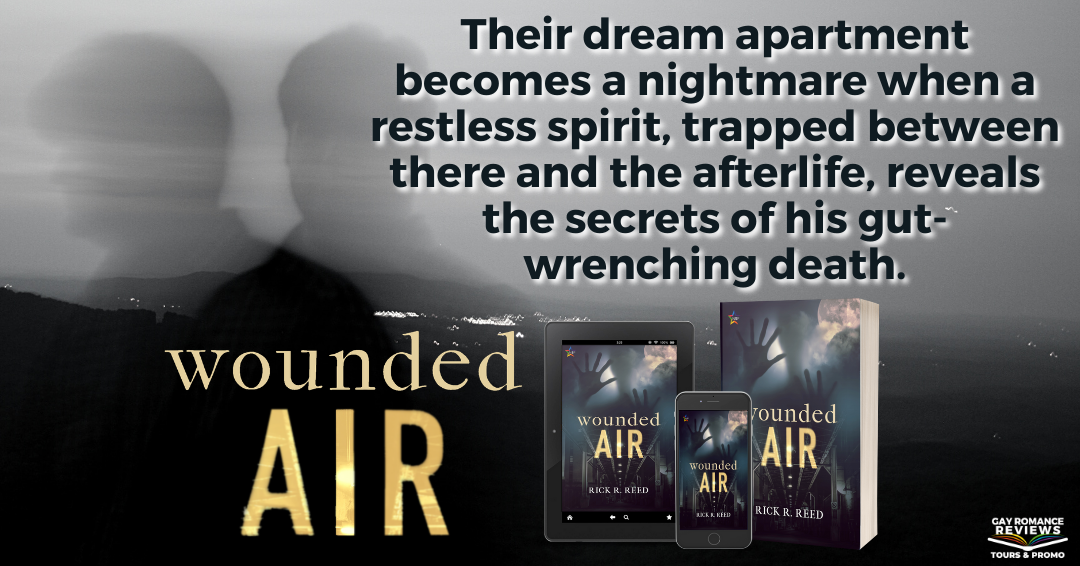
My Chilling Ghost Story: WOUNDED AIR


ABOUT THE BOOK

Rick and Ernie found the perfect apartment on Chicago’s West Side. Before they’re settled, Rick begins having all-too-real disturbing “dreams.” Each time, an emaciated young man with sad brown eyes appears, terrifying and obsessing him.

From their next-door neighbor, Paula, Rick learns about Karl and Tommy, who lived there before them. Tommy’s mysterious disappearance pains her. When she shares a photo of her with Tommy and Karl, Rick is shocked and troubled. Tommy is the man who appears to him in his dreams.

The ghostly visitations compel Rick to uncover the truth about Tommy’s disappearance. It’s a quest that will lead him to Karl, Tommy’s lover, who may know more about Tommy’s disappearance than he’s telling, and a confrontation with a restless spirit who wants only to—finally—rest in peace.

Buy

EXCERPT

In this scene, our hero, Rick, yearns for an unusual apartment he’s seen a million times from the Chicago L train he takes to work every day. But now, there’s something different—the apartment is available.

I never imagined my dream would come true.

But it did. And in a funny way, what drove me to this particular apartment led to a lot of dreams coming true.

But dreams can turn to nightmares in the space of a single breath.

Fate stepped in one day and changed everything—past, present, and future—when I rounded the bend of the L tracks and my glass-walled apartment came into view.

On that day, there was a change, a difference of two words.

Hanging as though suspended in midair was one of those black-and-red signs one can buy at the hardware store. The sign proclaimed: FOR RENT. Below the bright red letters was a white rectangle with a phone number written in black marker.

Oh my god. It’s coming true. This place will be gone by the afternoon! I can’t let anyone else have it.

I dug inside my messenger bag, groping for paper and pen to jot down the number. I’d call the moment I got to work, already feeling like I was racing against some imaginary clock hanging just above my head. Such a unique place wouldn’t be on the market for long. Hell, someone else might have already snatched it up.

I wasn’t fast enough to write the number. Of course, I wasn’t. The train had stopped for only a minute, two at the most, long enough to let a few folks off and a whole bunch on. There was a lot of chatter, the huffing of the train, the pneumatic hiss of the doors closing, and the garbled announcement for the next stop.

The apartment—and the FOR RENT sign—sailed by as it always did, and the phone number along with it. I turned in my seat, straining to try to see the number from this distance, even though I knew it was a stupid and impossible move.

I knew, as sure as anything, if I waited until the next day, with my pen poised and ready over a pad of paper, the sign would have vanished. Someone else would take possession of what I felt, in a weird and possessive way, was rightfully mine.

There was only one thing to do.

I tried to be patient despite my thundering heart, waiting until we neared the next station. I leapt up and edged my way through the crowd toward the doors. When they slid open, I stepped out and stood on the platform, giddy with my own impulsiveness. This wasn’t like me. I was usually a planner, every decision carefully considered before moving forward—or not.

Impulsive was something other people did.

On the platform, I paused for a moment, watching the southbound Brown Line train as it continued its journey toward the Loop. In the distance, the skyscrapers of downtown rose. A breeze rustled my hair. Autumn was definitely present, even though the sun peeked out through scattered clouds, drifting downward in illuminated shafts, like a religious painting. There was an undercurrent of chill that, at the time, I attributed to nothing more than the changing of seasons.

But now I wonder—was the chill an omen, foreboding? Was fate trying to tell me to get back on the next train and get to work like the safe and dependable guy I was? After all, I had a home and in it was a man I loved, a man to whom I hadn’t even whispered a word about wanting to move.

It was late autumn in Chicago and the day had all the portents of the coming winter. Gray, low-hanging clouds amassed near the horizon, some of them so dark they verged on black.

In the short time I stood there, the weather made a dramatic change, which, if you’ve ever visited Chicago, you know isn’t unusual. “Don’t like the weather?” Self-proclaimed wits were fond of saying about the Windy City. “Stick around for a few minutes, and it’ll change.”

The little sun there was vanished, beating a hasty retreat behind a bank of fast-moving and bruised clouds. Drizzle hung in the air. A needling, cold mist crept into my bones, making me shiver. This was worse than a downpour because it seemed like no matter how much one bundled up against it, the cold seeped into one’s bones, making it nearly impossible to get warm. The wind, which blew off the lake two miles east, picked up, running at a breakneck pace, westward bound, down Irving Park Road. I watched from the platform as the people below rushed to get out of the inclement weather, their umbrellas turning inside out. The wind ripped the last of fall’s leaves from their branches.

In spite of the weather, I made my way along the old wooden L platform to its northern end so I could stand directly in front of the object of my desire.

It was the first time I’d actually seen it up close. And now it almost looked unreal, as though it were a movie location dreamed up by the guy who did the set for Hitchcock’s Rear Window. My current view had that same urban, surreal feel, that same voyeuristic quality.

Looking back, I wondered if it also had that same air of menace Hitchcock was so noted for.

Buy


Friday, September 9, 2022

My Horror Collection, UNHINGED, is on Sale at Amazon!


For a limited time (and who knows why or how long?) #Amazon has priced the ebook & the paperback of my #horror collection, UNHINGED, at only $3.58. Grab a copy while the sale lasts! 

ABOUT THE BOOK

Horror. Romance. The two seem at odds, yet in provocative author Rick R. Reed’s hands, the pair merge like a match made in heaven ... or hell.

Prepare for a dark journey into an unhinged world populated by ordinary and extraordinary monsters. Unhinged brings you sometimes chilling, sometimes romantic, sometimes hilarious, but always thought-provoking tales.

Among them you’ll find a chilling and redemptive ghost story, a most unusual and shocking first meeting for two lovers, a story revolving around one of the 20th Century’s most horrific serial killers, and a darkly comic take on the vampire mythos. This collection will make your heart race with passion ... in all its forms.

Contains the stories: Echoes, How I Met My Man, The Man from Milwaukee, Sluggo Snares a Vampire, The Ghost in #9, and Incubus.

BUY
#Kindle 
#Paperback

Thursday, September 8, 2022

My Urban Ghost Story, WOUNDED AIR, Gets a Rave


It's wonderful to stumble across a positive review you didn't know about for one of your books. This one, from A REVIEWER DARKLY had some very positive words for my urban ghost story revolving around addiction:


“The first thing a prospective reader should know before starting Wounded Air is that this is not an easy novel to read.  Reed is unrelenting and brutal in his portrayal of drug use and the destruction it brings.  The story jumps right in and does not pull any punches as it details the decline of the couple once they experiment with drugs.  Reed does recognize that there are some very difficult chapters in this novel and alternates between the past and the present to try to soften the blow but even the horror in the present only softens the blow while also seeming to somewhat amplify it as well.  This is definitely not a book for the weak of heart or stomach.  There were times I felt a bit sickened by the events of the novel but found that it was well worth the read.

“Wounded Air is as compelling as it is brutal.  It works on many different levels and Reed plays on the reader's emotions on multiple levels.  At its core, Wounded Air is a love story even though it is not a traditional love story.  This is a love story gone wrong through the best of intentions as an attempt to bring the lovers even closer ends up in destruction and isolation.  It is also the story of a man coming to terms with his place in the world and learning to make the tough but necessary decisions.  It is a tale of horror from beyond the grave and even greater horror on this side of death.  The novel is hard to describe without giving away key elements of it so I do not want to go much deeper.  What Wounded Air is harsh, scary, and haunting.  It is not the best book that I have ever read but I do think that it is one that I will probably never forget."

Read the whole review here:
https://areviewerdarkly.blogspot.com/2021/08/ghosts-live-in-poison-smoke-in-rick-r.html

Buy Wounded Air